



When Can a Toddler Use a Learning Tower? Age and Safety
A learning tower looks like a toddler thing, but exactly when a toddler is ready for one is less obvious. Start too early and the platform is a stretch; wait too long and you have missed the months when a child most wants to help at the bench. This guide walks through the right age to begin, the signs of readiness to look for, how to use the frame safely at each stage, and when children finally outgrow it.
In This Article:
- The Right Age to Start
- Signs Your Toddler Is Ready
- Using It Safely at Each Stage
- Building the Habit
- How Long Will They Use It
- Safety and Australian Standards
- Frequently Asked Questions
The Right Age to Start
Most children are ready for a learning tower at around eighteen months, though the range is wide. Some are steady on their feet and keen to help from twelve to sixteen months; others are content to watch a while longer, and both are perfectly normal. Age is a rough guide, not a rule. What matters more is if your child can stand and balance well on their own, because the tower's job is to hold a child who is already walking confidently, not to prop up one who cannot yet stand unaided.
The platform on most frames starts high for a small toddler and drops a level as they get taller, so a tower bought at eighteen months has years of use ahead of it. If your child is on the younger side, a clip-on safety net closes the entry gap for the first stretch while their balance settles, which lets a keen early walker join in sooner without standing at an open side.
There is no prize for starting early. A child who first climbs in at two takes to the frame just as happily as one who began at fourteen months, and often with less fuss, since their balance and their patience have both had longer to arrive. Read your own child rather than the calendar.
Signs Your Toddler Is Ready
Rather than counting months, watch what your child can already do. A few signs that a tower will suit them:
- They stand and walk steadily without holding on, and can lower themselves back to the floor with control.
- They pull up to the bench or the coffee table and clearly want to see what is happening up there.
- They can follow a simple instruction, like stop or sit down, most of the time.
- They show interest in helping, reaching for the tap, the bowl, or the toothbrush.
If most of those are true, your child is ready to try a tower with you standing close by. If standing is still wobbly, or they cannot yet get down from the couch without a tumble, give it a few more weeks and check again. None of these signs has to be flawless; you are looking for a child who is steady and interested, not one who has mastered every one.
Every child arrives here on their own timing, and a short wait costs nothing. A fortnight of extra steadiness makes those first sessions in the frame calmer for both of you.

Using It Safely at Each Stage
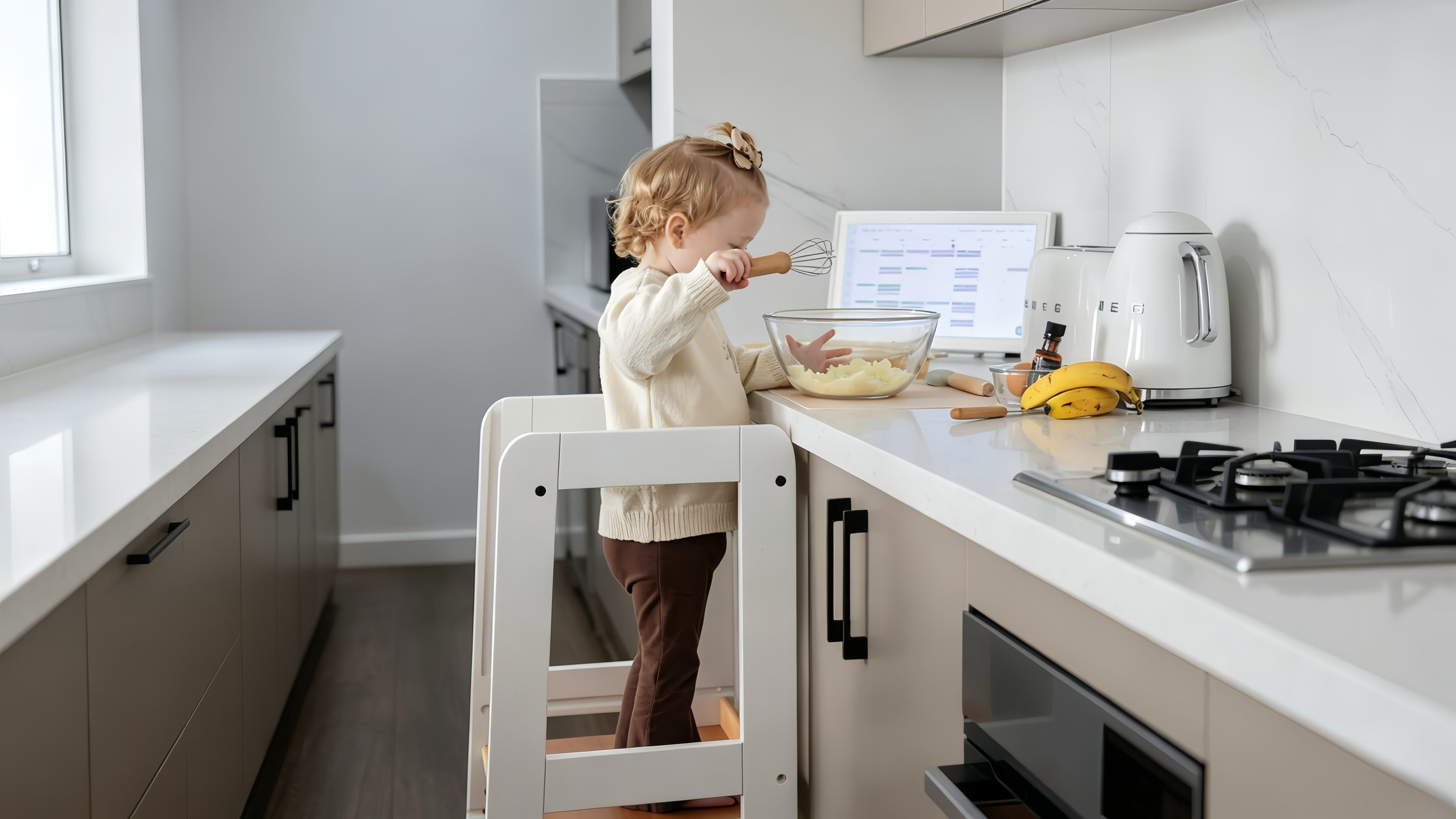
How you use the frame shifts as your child gets older. For a new, younger climber, set the platform to its highest level so the sides sit tall around them, add a safety net across the opening, and keep a hand nearby every time they are up. Give them a small job to focus on, washing a potato or stirring a bowl, so they stay settled in the frame rather than leaning out after something on the far side of the bench.
As balance improves through the second and third years, you can drop the platform a level so their forearms rest comfortably on the bench, and retire the net once they climb in and out with control. This is the point where most families lean on an adjustable frame like the LOLA or the step-stool JALA, since the height keeps pace as your child gets taller and the frame stays useful year after year.
Whatever the age, a few rules stay the same: one child in the frame at a time, the tower back from the stove whenever it is on, and always an adult in the room. Set those from the first day and they become second nature long before your child is old enough to test them.
Building the Habit
A learning tower works best as part of a routine rather than a one-off treat. Children settle fastest when the frame has a regular home at the bench and a regular job to go with it, so they know what happens when they climb in. Something as small as rinsing vegetables, tearing lettuce, or pushing a wooden spoon around a bowl gives a toddler a reason to stay put and a real part in the meal.
Keep the first sessions short and low-stakes. Five minutes of stirring while you cook alongside is plenty at the start, and it is easier to end on a good note than to stretch a session until everyone is frazzled. Over weeks, those short stretches add up to a child who is comfortable and capable at the bench, and who has learned the climb-in, ask-for-help routine without a fight.
It also helps to clear the bench in front of the frame before your child climbs in. A tidy stretch of benchtop, with knives and hot pans moved well back, means the space in front of them is theirs to work in and there is nothing tempting just past the rail.

How Long Will They Use It
A learning tower usually stays useful until around five or six. A toddler who starts at eighteen months will still be baking on weekends at school age, and an adjustable frame drops through its levels across that whole stretch, so a single tower covers the years a child most wants to be at the bench. That long run is part of why the frame earns its place in the kitchen rather than gathering dust after a few months.
Two things tell you a child has outgrown it: they step up to the bench easily without the platform, and they are near the maker's stated height or weight limit for the frame. At that point a plain stool does the job, and a convertible frame like the TOVA can carry on as a table and chairs even after the standing tower is no longer needed. There is no need to rush the change; most children make it clear when the tower has done its work, usually by climbing out and heading for a normal stool on their own.
Safety and Australian Standards
Whatever the age, setup carries most of the safety. Keep the tower on a flat, level floor, move it back whenever the cooktop is on, wipe the step so it stays grippy underfoot, and check the height bolts every so often so nothing works loose over months of use. Never leave a toddler standing in the frame alone, even for a moment, and teach the same rule from the very first day: climb in, face the bench, and ask for help getting down.
On the build side, our learning towers are independently tested against AS/NZS ISO 8124, the Australian and New Zealand safety standard for toys, across all three parts: AS/NZS ISO 8124-1:2023 covers the mechanical and physical properties, AS/NZS ISO 8124-2:2023 covers flammability, and AS/NZS ISO 8124-3:2023 covers the migration of certain elements from the materials. That testing sits behind the enclosed sides and the locking height mechanism, but no standard replaces an adult within arm's reach.
For a fuller look at the range and the styles on offer, from adjustable frames to folding and convertible ones, the learning tower buying guide runs through each type and who it suits.
Frequently Asked Questions
What age can a toddler start using a learning tower?
Most are ready at around eighteen months, though some steady walkers start from twelve to sixteen months with an adult close by. What counts is if your child can stand and balance well on their own, not the exact age.
Is twelve months too young for a learning tower?
Not always. A child who walks steadily and can lower themselves to the floor with control can start around then, with the platform at its highest setting and a clip-on safety net across the opening. If standing is still wobbly, wait a few weeks and try again.
When do children stop using a learning tower?
Usually around five or six, once they can step up to the bench on their own or reach the frame's height or weight limit. An adjustable tower stretches that span by dropping a level as your child gets taller.
Do you need a safety net with a learning tower?
A clip-on safety net is worth it for the first few months, especially with a younger or newer climber, since it closes the gap at the opening while their balance settles. Many families retire it once their child climbs in and out on their own with control.
Ready to bring one home? Browse the full learning tower range and pick the frame that fits your child's stage.





Leave a comment
This site is protected by hCaptcha and the hCaptcha Privacy Policy and Terms of Service apply.