



Folding vs Convertible Learning Towers: Which Suits Your Space?
Some kitchens need the tower gone the moment cooking stops; others would rather it stayed and did a second job. Folding and convertible towers answer those two wishes in different ways, and choosing between them comes down to what you want the frame to do once your toddler climbs down. Neither is simply better than the other, so the right pick depends on your room and your routine. Here is how the two compare.
In This Article:
- Two Ways to Solve the Space Problem
- How a Folding Tower Works
- How a Convertible Tower Works
- Which One Suits Your Kitchen
- What Each One Asks in Return
- Setting Up Either One Safely
- Frequently Asked Questions
Two Ways to Solve the Space Problem
A standard learning tower lives at the bench and stays there. In a roomy kitchen that is no trouble, but in a tight galley, an apartment, or a space that doubles as the dining room, a fixed frame can quickly become one thing too many on the floor. It is the most common reason families hesitate over a tower at all: they want their child at the bench, but not at the cost of a permanent obstacle underfoot.
Two designs answer that worry in opposite ways. A folding tower tackles storage head on: it flattens and slides away between uses, so the floor comes back the moment you need it. A convertible tower takes the other route, changing shape so the frame keeps earning its spot rather than standing idle at the bench all day. One disappears; the other transforms.
That difference is the whole decision in miniature. Before comparing features, work out which problem you are actually solving: a genuine shortage of floor space, or a frame you would rather not leave sitting unused for most of the day. Name the problem first and the style tends to pick itself.
How a Folding Tower Works
A folding tower is built around a hinge. When cooking is done, you fold the frame flat and stand it against a wall, slide it beside the fridge, or tuck it into a pantry or a hall cupboard. Reopening takes a few seconds, and the platform locks back into a full, enclosed standing frame with sides a child can hold. The MILA works this way, and it still adjusts in height once it is open, so folding does not cost you the feature most families rely on.
Birch plywood does a lot of the quiet work here. It is light enough to fold and carry one handed, yet strong across the hinge, which is why folding frames lean on it rather than a denser hardwood. That lightness matters more than it sounds: a frame you can lift with one arm while holding a toddler with the other is a frame that actually gets folded away, rather than left standing because moving it is a bother.
If your kitchen shares a room with the dining table, or the floor has to clear each evening for a pram and a highchair as well, a folding frame is usually the easier of the two to live with day to day. The one habit it asks for is a spot to fold it into, so decide where it will live closed before it arrives.

How a Convertible Tower Works
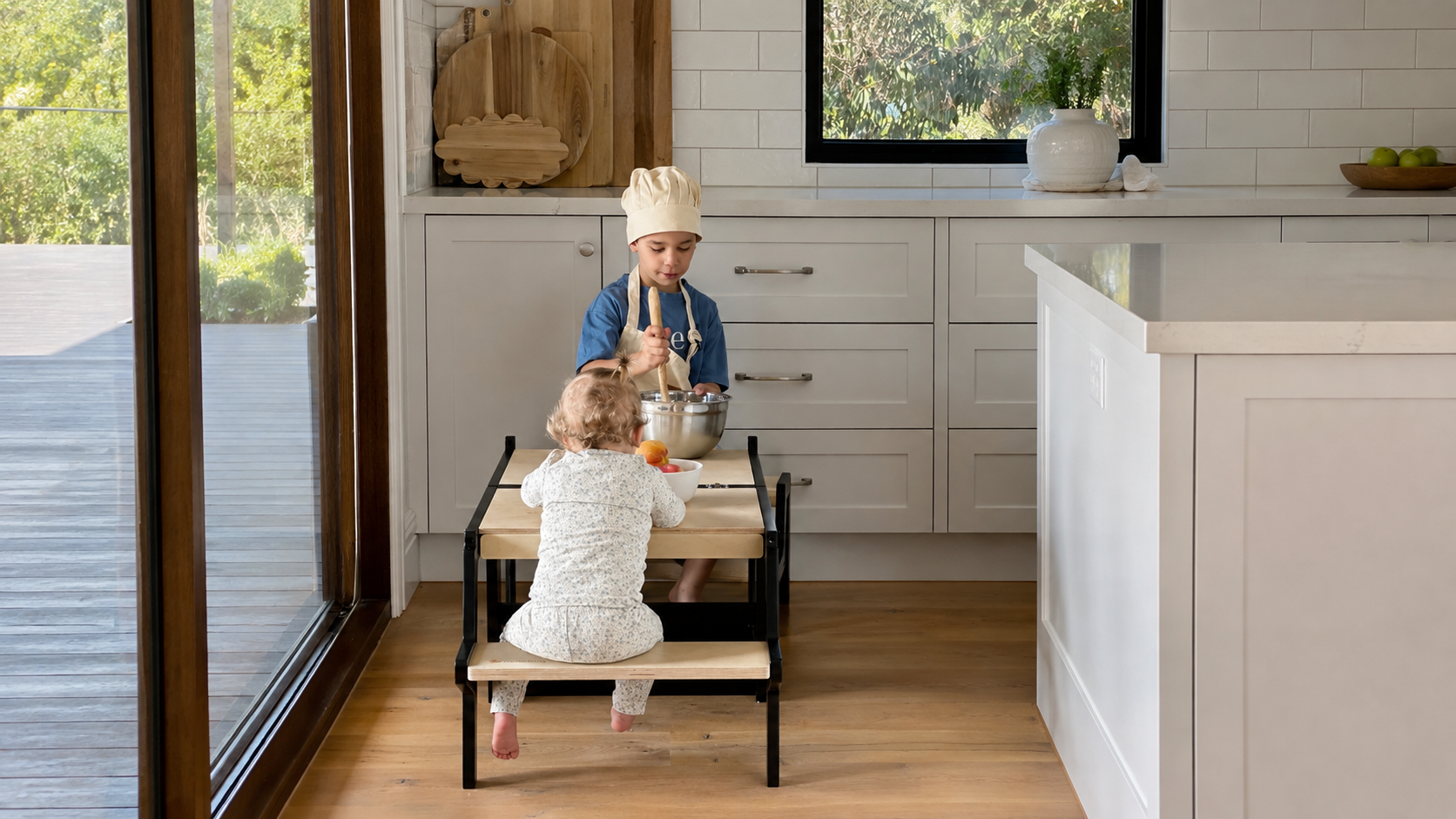
A convertible tower does not fold away; it becomes something else. The TOVA converts from a standing tower into a table and two chairs, so once the cooking finishes the same timber turns into a spot where two children can sit to draw, snack or work on a puzzle. Its side panels double as a drawing surface, and a drawer holds pencils and supplies, so the second shape is a real piece of furniture rather than a token extra.
The trade is height. Rather than adjusting the platform up and down, a convertible frame holds one standing height and earns its keep through the second shape instead. It also includes a step stool, so between meals it can still give a boost at the basin or the light switch. For a family with two children close in age, or a kitchen where a small table would be welcome anyway, that flexibility keeps the frame busy far more of the day than a tower that only appears at dinner.
What it does not do is shrink. A convertible frame takes up much the same footprint whichever shape it is in, so it suits a room that already has space for a small table, not one where the floor has to be cleared each night. Its strength is a second job, not disappearing.

Which One Suits Your Kitchen
Line the two up against your own room and the choice usually settles quickly:
- Short on floor space, or sharing with the dining table? A folding MILA clears out when you need the room back, then reopens in seconds.
- Want the frame to keep working after dinner? A convertible TOVA becomes a table and two chairs, so it carries on as a drawing spot.
- Two children who both want to help, or to sit down together? The convertible's two seats let them share rather than take turns.
- Need the platform to drop a level as your child gets taller? Folding keeps full height adjustment; a convertible holds one height and adapts by changing shape.
Neither is the better tower on paper. A folding frame wins on pure storage; a convertible one wins on second uses. If you are still weighing them against the rest of the range, the learning tower buying guide sets both beside the adjustable and tower-plus-stool styles as well.
What Each One Asks in Return
Neither style is free of small compromises, and knowing them upfront saves second-guessing later.
A folding tower asks for a routine and a hinge. You fold and unfold it around each session, and there is a moving joint to keep an eye on, so a quick check that it has locked fully open becomes part of using it. In return you get your floor back and a frame that stores almost anywhere. If nobody in the house will bother folding it, though, much of the point is lost, and a fixed tower might serve you better.
A convertible tower asks you to give up height adjustment and to find room for its footprint full time. Reconfiguring it between tower and table takes a moment and a little care to lock each shape, and it is heavier to shift than a light folding frame. In return the frame does two jobs and rarely sits idle. It rewards a household that wants a small table anyway and has the space to leave it out.
Put simply: a folding tower trades a small daily habit for reclaimed floor space, while a convertible one trades adjustable height and a fixed footprint for a genuine second use.
Setting Up Either One Safely
Both styles ask for the same habits once they are open. Stand the frame on a flat floor, move it back from the cooktop while the stove is on, and stay within arm's reach while your toddler is up. On a folding frame, check that the hinge has locked fully open before anyone climbs on; on a convertible one, follow the maker's steps for locking each shape in place first. Teach one rule early: climb in, face the bench, and ask for help getting down.
For the first few months, a clip-on safety net closes the entry gap while your child finds their footing in either frame. On the build side, our learning towers are independently tested against AS/NZS ISO 8124, the Australian and New Zealand safety standard for toys, across all three parts: AS/NZS ISO 8124-1:2023 for mechanical and physical properties, AS/NZS ISO 8124-2:2023 for flammability, and AS/NZS ISO 8124-3:2023 for the migration of certain elements. That testing sits behind the hinges and locks, but an adult in the room stays the most important part of the setup.
Frequently Asked Questions
Is a folding or convertible learning tower better for a small kitchen?
A folding tower like the MILA is usually the better fit for pure floor space, since it flattens and stores away between uses. A convertible TOVA helps in a different way: it doubles as a table, so it is less likely to sit idle taking up room.
Does a folding learning tower still adjust in height?
Yes. The MILA folds flat for storage but reopens to a full adjustable frame, so you can still drop the platform a level as your child gets taller.
What does a convertible learning tower turn into?
The TOVA converts from a standing tower into a table and two chairs, with side panels that double as a drawing surface and a drawer for supplies. It also works as a step stool between meals.
Which is heavier to move, a folding or convertible learning tower?
A folding tower is generally the lighter of the two to lift and shift, since it is built to be carried and stored between uses. A convertible frame is sturdier and stays put more readily, which suits a tower that lives in one spot rather than moving around the kitchen.
Still deciding? Browse the full learning tower range and match a frame to the way your kitchen runs.





Leave a comment
This site is protected by hCaptcha and the hCaptcha Privacy Policy and Terms of Service apply.