


Learning Towers Compared: Which One Is Right for Your Child?
Once you have decided a learning tower belongs in your kitchen, the next question is which one. Adjustable, folding, convertible, tower-plus-stool: the styles all look alike in a photo, yet they suit very different kitchens and families. This guide explains what sets them apart and gives you a simple way to land on the right one.
In This Article:
- What a Learning Tower Does
- The Main Types, and Who They Suit
- Matching the Tower to Your Kitchen
- Timber and Finish
- The Range at a Glance
- Safety and Australian Standards
- Frequently Asked Questions
What a Learning Tower Does
A learning tower is a raised, enclosed platform that brings a toddler up to bench height so they can stand safely and help. The panels or rails on each side hold a child who leans or turns, which is what separates a tower from a plain step stool. Most towers adjust in height, so the platform can start high for a small toddler and drop a level as they get taller.
It helps to picture a tower as the step between a high chair and a plain kitchen stool. A high chair keeps a baby contained but out of the action; a stool leaves an older child balanced on a narrow perch with nothing to hold. The tower sits in between, giving a toddler a solid floor to stand on and a frame on all sides for the years when their balance is still settling. That is why most families keep one at the bench for washing vegetables, stirring a bowl or pouring, and why the same frame often moves to the bathroom basin for tooth-brushing and hand-washing.
Beyond that shared idea, the range splits into a few clear types. Getting the type right matters more than the name on the box, because it decides how the tower fits your kitchen, how it stores, and how long it stays useful.
The Main Types, and Who They Suit

Almost every learning tower on the Australian market falls into one of four styles. They share the same core job, a safe platform at bench height, but each solves a slightly different problem around it: storage, a second use, or a boost somewhere else in the house.
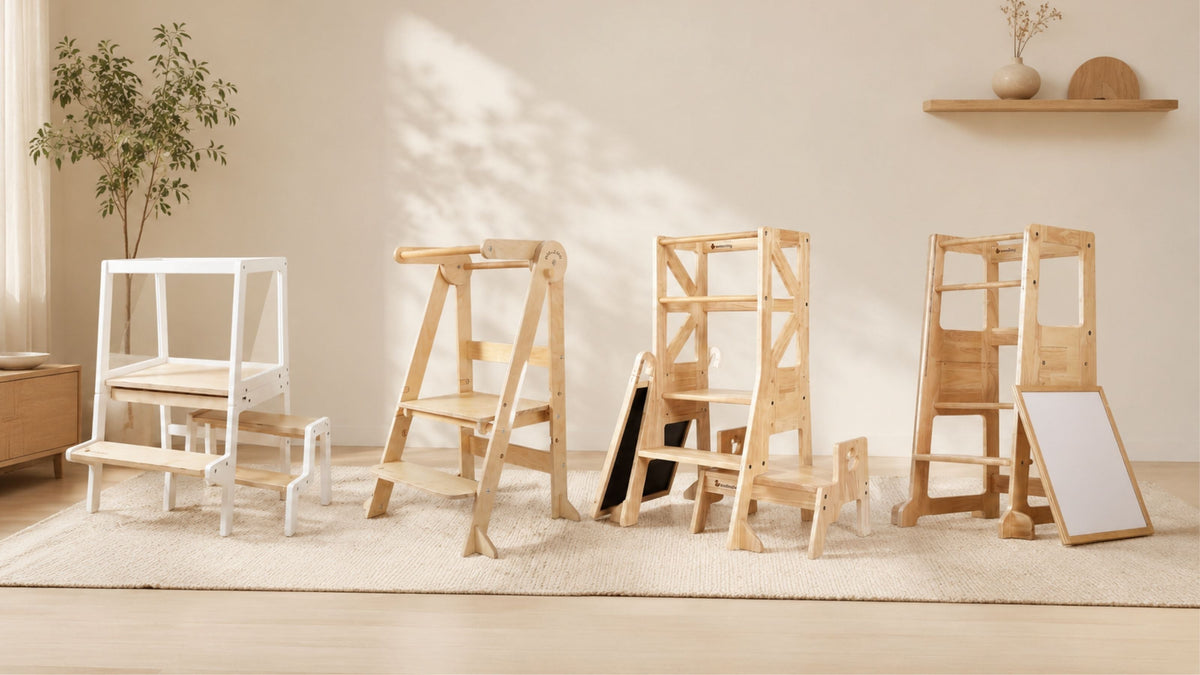
- Adjustable tower with a drawing board. The classic choice: the platform steps up and down as your child gets taller, and an included drawing board turns a quiet stretch into drawing time. The LOLA range works this way, in a few timber options.
- Tower plus step stool. Here the frame does double duty as a standalone step stool, for a quick boost at the basin or the light switch. The JALA is the two-in-one option.
- Folding tower. Built to flatten and slide away between uses, so it suits a galley kitchen or a shared dining space. The MILA folds slim, then reopens to a full adjustable frame.
- Convertible tower. Instead of adjusting height, it transforms. The TOVA converts from a standing tower into a table-and-chair set with two seats, so two children can sit down to eat or draw, with clear side panels that double as a drawing surface and a drawer for supplies.
The lines between them are not rigid. A LOLA is the frame most families start with; a JALA suits a house where you also want a spare step; a MILA answers a space problem; a TOVA answers the question of what the tower does once the cooking is finished. Reading the type against your own kitchen, rather than the photo, is the quickest way to narrow the field.
Matching the Tower to Your Kitchen
Start with your space and how you cook:
- Tight kitchen, or one that doubles as the dining room? A folding tower like the MILA packs away when you need the floor back.
- Want the tower to earn its keep after dinner? A convertible TOVA becomes a table and two chairs, so it carries on as a drawing spot once the cooking is done.
- Need a boost around the house, not just at the bench? A tower-and-stool JALA gives you a separate step for the bathroom or the front door.
- Just want a steady frame at the bench with room to draw? A LOLA lives at the bench full time and comes with a drawing board.
- Two children close in age? The TOVA's two-seat table lets them sit together rather than taking turns.
There is no single best tower, only the one that matches how your kitchen runs. Note your bench height and the floor space you can spare before you choose, since those two numbers rule some options in or out on their own.
If you are still torn, think about the room a few years out, not just this month. A toddler who starts at the bench at eighteen months will still be baking on weekends at five or six, so the frame you buy now has a long run ahead of it. An adjustable model drops a level as your child gets taller and keeps pace with that stretch; a convertible one changes its job as the children who use it change. Either way, the tower that keeps earning its spot is the one that suits the room, not the one that looked best in a single photo.
Timber and Finish
Learning towers are usually made from plywood or a solid hardwood, and the choice changes the weight and the feel more than the safety. Birch plywood is light, strong, and easy to move around the kitchen, which is why the folding and convertible frames tend to use it. Hardwoods like rubberwood and beechwood are heavier and denser, with a smoother grain that some families prefer to look at.
The LOLA range shows the spread: the standard LOLA is plywood, the LOLA Deluxe steps up to rubberwood, and the LOLA Pro uses beechwood. Whichever you pick, look for smooth rounded edges and a non-toxic finish you can wipe clean, since flour, yoghurt and paint all end up on the frame sooner or later.
Weight is worth a thought if the tower will move a lot. A plywood frame is light to slide from the bench to the sink and back, or to lift out of the way at the end of the day, which suits a busy kitchen. A denser hardwood frame stays put more readily and feels more solid underfoot, which some families prefer for a tower that lives in one spot. Neither is safer than the other, and the testing behind the frame is the same, so this really comes down to how you will use it and how it sits with the rest of your kitchen.
The Range at a Glance
Every frame here is compatible with a clip-on safety net. Here is how the models line up:
| Model | Adjusts | Step stool | Drawing board | Folds | Converts | Timber |
|---|---|---|---|---|---|---|
| LOLA Pro | Yes | No | Yes | No | No | Beechwood |
| LOLA Deluxe | Yes | No | Yes | No | No | Rubberwood |
| LOLA | Yes | No | Yes | No | No | Plywood |
| JALA Deluxe | Yes | Yes | Yes | No | No | Rubberwood |
| JALA | Yes | Yes | No | No | No | Plywood |
| MILA | Yes | No | No | Yes | No | Plywood |
| TOVA | Yes | No | No | No | Yes | Plywood |
Safety and Australian Standards
Whichever type you choose, the way you set it up matters most. Keep the tower on a flat floor, move it back from the cooktop whenever the stove is on, and stay within arm's reach while your child is standing in it. Teach one rule early: climb in, face the bench, and ask for help getting down. Never leave a toddler alone up there.
For the first few months, a clip-on safety net closes the entry gap while your child finds their feet. Wipe the step so it stays grippy, and check the height bolts every so often. Giving your child a job to focus on also keeps them settled in the frame rather than reaching out for something on the far side of the bench.
Setting the platform to the right level makes a real difference too. Too low and your child stretches up over the edge; too high and the bench is out of comfortable range. Aim for a height where their forearms rest naturally on the benchtop, and drop the platform a notch when you notice them standing on tiptoe or leaning in. On a convertible frame, follow the maker's steps for locking each shape in place before anyone climbs on.
On the build side, our learning towers are independently tested against AS/NZS ISO 8124, the Australian and New Zealand safety standard for toys, across all three parts: AS/NZS ISO 8124-1:2023 covers the mechanical and physical properties, AS/NZS ISO 8124-2:2023 covers flammability, and AS/NZS ISO 8124-3:2023 covers the migration of certain elements from the materials. That testing sits behind the enclosed sides and locking mechanisms, but an adult in the room is still the most important safety feature.

Frequently Asked Questions
Which learning tower is best for a small kitchen?
A folding model like the MILA is the usual pick, since it flattens and slides away when you need the floor back. A convertible TOVA also helps, because it doubles as a table rather than sitting idle at the bench.
What is a convertible learning tower?
It swaps between jobs instead of only adjusting height. The TOVA converts from a standing tower into a table-and-chair set with two seats, with side panels that double as a drawing surface.
Are all the towers height-adjustable?
Most are, including the LOLA, JALA and MILA. The convertible TOVA is the exception: rather than raising the platform, it changes shape to suit the task.
Still weighing it up? Browse the full learning tower range and match a frame to the way your kitchen runs.





Leave a comment
This site is protected by hCaptcha and the hCaptcha Privacy Policy and Terms of Service apply.