
When Do Babies Start Walking? A Milestone Guide for Australian Parents
Few milestones are watched as closely as the first steps. One week a baby is pulling up on the couch, the next they are letting go with one hand and grinning at you. Walking arrives on a wider timeline than most parents expect, and the wobbly months before it follow a fairly predictable order. This guide covers when babies start walking, the stages that lead up to those first steps, how a push walker fits in, and when a late walker is worth raising with your health nurse.
In This Article:
- When Do Babies Take Their First Steps?
- The Stages Before Walking
- Cruising: The Step Just Before Walking
- How a Push Walker Fits In
- Signs Your Baby Is Getting Close
- Encouraging Walking Without Rushing
- When a Late Walker Is Worth a Word
- Frequently Asked Questions
When Do Babies Take Their First Steps?
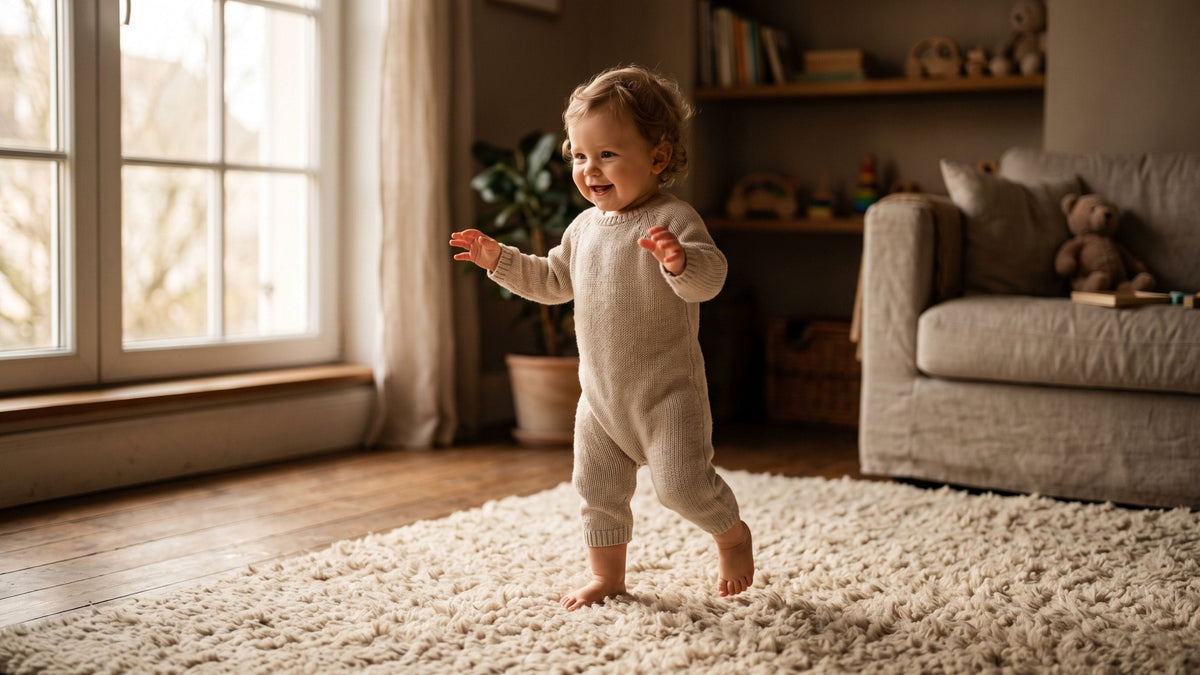
Most babies take their first independent steps somewhere between nine and eighteen months, with the average landing close to their first birthday. That is a nine-month spread, and every point along it is normal. A baby who walks at ten months is not ahead of one who waits until sixteen; they are simply two healthy babies on different timelines.
Because the range is so wide, the birthday itself tells you very little. A baby's build, temperament and how much floor time they get all shift the timing. Cautious babies often watch and practise for weeks before they commit, while bolder ones launch off and fall over plenty. Both get there, and how early a baby walks has no bearing on how well they walk, run or climb later on.
It also helps to know that walking is one of the last big physical milestones of the first year or so, built on top of everything that came before it. To understand when first steps arrive, it is worth looking at the stages that lead up to them.
The Stages Before Walking
Walking is the top of a staircase a baby climbs one step at a time. Each stage builds the strength and balance the next one needs, which is why they tend to arrive in the same order even though the timing varies.
Sitting without support usually comes first, around six to eight months, as a baby's trunk gets strong enough to hold them upright. Crawling or shuffling often follows, though some babies skip crawling altogether and go straight to pulling up. Pulling to stand against furniture tends to appear around eight to ten months, once the legs can take some weight. After that comes cruising, and then, when the balance is there, letting go.
This same climb from rolling to sitting to standing is one we have written about before. If your baby is at the earlier end of it, our guide on when babies start to roll over covers the stage that opens the whole sequence.
Cruising: The Step Just Before Walking
Cruising is the name for that stretch when a baby walks sideways while holding onto the couch, the coffee table or a parent's hands. It is the rehearsal for walking, and it is where a baby learns the two things first steps depend on: shifting weight from one leg to the other, and staying balanced while they do it.
Most babies cruise for a few weeks to a couple of months before they let go. You will often see them work along the length of the couch, then face the gap to the next piece of furniture and weigh it up before lunging across. Those gaps are where the confidence gets built, one hand-hold at a time, until one day they cross with no hands at all.
A cruising baby is telling you the legs are strong and the balance is nearly there. This is the stage where a push walker starts to earn its place, giving a baby something steady to hold and move behind once they are ready to face forward rather than sideways.

How a Push Walker Fits In
There are two very different products that share the word walker, and it is worth being clear about which is which. A seated walker holds a baby in a frame on wheels so they scoot around with their feet. A push walker is the opposite: the baby stands behind it on their own two feet and pushes it along, holding the handle for balance. The push type is the one that supports the walking a baby is already learning.
A push walker gives a cruising baby a moving hand-hold, so they can practise stepping forward instead of sideways along the couch. A wooden push walker adds a little useful weight and resistance, so it rolls steadily rather than shooting away from a new walker. Look for wheels with a soft rubber rim, which grip the floor and slow the roll, and a handle at a height the baby can hold without hunching.
A push walker is a helper, not a teacher. Babies learn to walk by falling over and getting up on open floor, and the walker is simply one more thing to hold on the way. If you want a fuller rundown of the type, our guide to choosing a first push walker walks through what to look for.
Signs Your Baby Is Getting Close
Once cruising is underway, a handful of signs tell you first steps are not far off. A baby who can stand unsupported for a few seconds, letting go of the furniture without noticing, has the balance walking needs. So does one who bends down to pick up a toy from standing and rights themselves again without toppling.
Watch for a baby who cruises with only one hand on the furniture, or who pushes a sturdy object across the room and follows it on their feet. Both show the legs are doing the work and the hands are only there for reassurance. Many babies also go through a phase of climbing everything in sight around this time, another sign the legs are strong and the drive to move is high.
When you see these signs, the job at home is mostly to clear the way and let it happen. A stretch of open floor, a soft surface for the falls, and a steady object or two to push are more use than any amount of coaxing.
Encouraging Walking Without Rushing
You cannot make a baby walk before their body is ready, but you can set the room up so practice comes easily. Barefoot time on a firm floor helps more than shoes indoors; bare feet grip and feel the ground, and that feedback is part of how balance is learned. Save the first proper shoes for outdoor walking, once the steps are steady.
Give a baby reasons to cross open space. Sitting a short distance away and holding out a favourite toy, or setting two adults a couple of steps apart, turns walking into a game with a reward at the end. Furniture set a small reach apart lets a cruiser plan their own crossings, and a push toy gives them a moving anchor when they are ready to leave the furniture behind.
What does not help is worry about the calendar. A baby who is cruising and pulling up is on track, whether the first steps come this month or in three. Steady floor practice, plenty of chances to move, and a calm response to the falls do far more than any push toy or drill.

When a Late Walker Is Worth a Word
The wide age range means most late walkers are simply taking the slower path to the same place, and get there with no fuss. Still, a few signs are worth raising with your GP or child health nurse rather than waiting out.
It is reasonable to check in if a baby is not walking at all by around eighteen months, is not pulling up to stand by twelve months, or has stopped doing something they could do before. The same goes for a baby who only ever uses one side of their body, who stays up on their toes and cannot get their heels down, or whose legs seem very stiff or very floppy when they bear weight. None of these means something is wrong on its own; they are simply worth a professional eye.
Australian families have the child health nurse and the regular checks for exactly this. If something about the way your baby moves sits oddly with you, that instinct is worth a conversation. More often than not you will be reassured, and if there is anything to act on, earlier is better.
Frequently Asked Questions
What age do most babies start walking?
Most babies take their first independent steps between nine and eighteen months, with the average close to the first birthday. The range is wide, and every point along it is normal. How early a baby walks has no bearing on how well they walk later.
Do push walkers help babies learn to walk sooner?
A push walker gives a cruising baby a steady, moving hand-hold to practise stepping forward, but it does not make walking arrive sooner. Babies learn to walk by practising on open floor. A wooden push walker is one useful thing to hold along the way, not a teacher.
Is a seated baby walker the same as a push walker?
No. A seated walker holds a baby in a wheeled frame so they scoot with their feet. A push walker sits in front of a standing baby, who pushes it along on their own two feet. The push type supports the walking a baby is already learning to do.
When should I worry that my baby is not walking?
Most late walkers are simply on a slower timeline and get there. It is worth raising with your GP or child health nurse if a baby is not pulling up to stand by twelve months, not walking at all by around eighteen months, or has lost a skill they used to have.
Have a baby who is cruising the furniture? See both push-along options in the baby walker range, including a doll pram that doubles as a walker for older toddlers who are already on their feet.





Leave a comment
This site is protected by hCaptcha and the hCaptcha Privacy Policy and Terms of Service apply.