
Indoor Swings for Kids: Types, Ages and Hanging One Safely
An indoor swing solves a problem every Australian parent knows: a child with energy to burn and a day too wet or too hot to head outside. Swinging is more than a way to fill an afternoon, though. The steady back-and-forth feeds a child's sense of balance and movement, and for many children it is calming as much as it is active. This guide walks through the swing seats and the disc swing, the age each one suits, and the part that matters most before any of it: what you hang the swing from.
In This Article:
- Why an Indoor Swing Earns Its Place
- The Swing Seats: From Baby to Bigger Kids
- The Disc Swing: Balance and Freer Movement
- Sensory Swinging and Winding Down
- What You Hang It From
- Matching the Swing to Your Space and Child
- Frequently Asked Questions
Why an Indoor Swing Earns Its Place
Swinging works the parts of a child that sitting still does not. The back-and-forth motion feeds the sense of balance and body position that a young child is still building, and pumping the legs or holding on builds strength along the way. It is active play that happens in one spot, which is part of why it suits a room rather than only a backyard.
The other half is calm. Slow, rhythmic swinging settles many children, and a swing indoors gives them a place to wind down as well as let off steam. On a stretch of rainy days, having somewhere to move inside can be the difference between a restless afternoon and a settled one, without waiting for the weather to turn.
Because an indoor swing hangs from a single fixed point, it asks for very little floor. You need clear space around it to swing freely, but the swing itself takes up no more room than the child using it. That makes it a realistic addition to a playroom, a bedroom, or a covered outdoor area, rather than something that needs a yard to justify.

The Swing Seats: From Baby to Bigger Kids
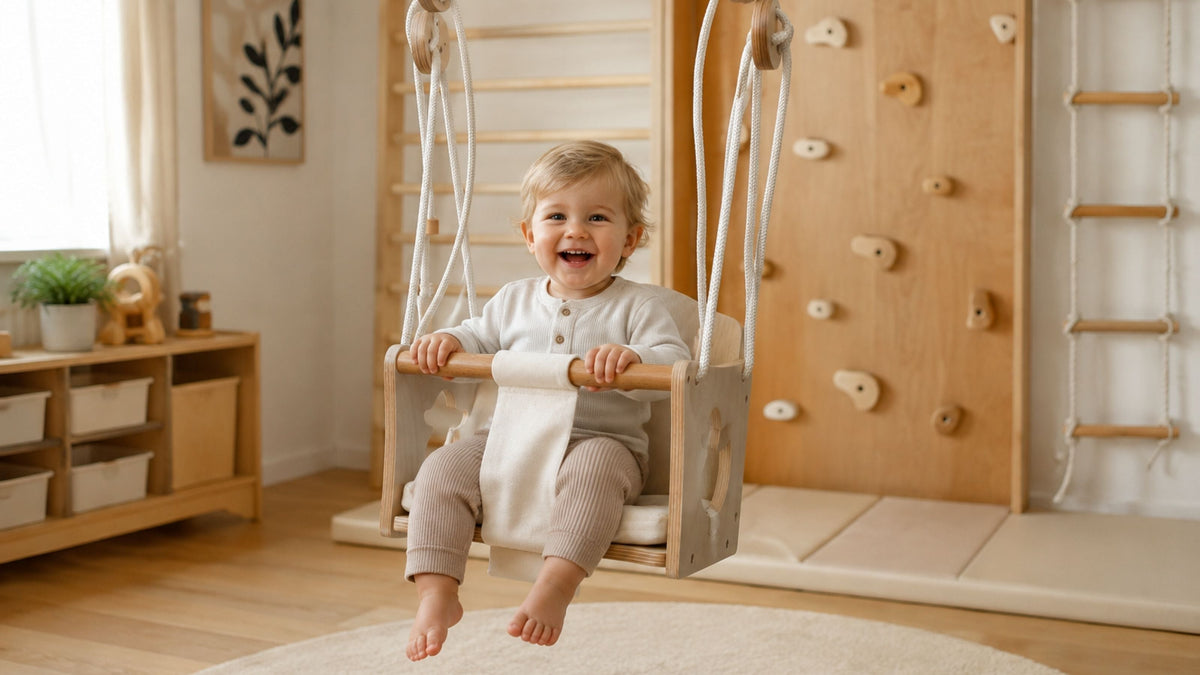
The starting point for the youngest children is a supported swing seat. The baby swing seat suits children from around six months, once they can sit up with support, through to about three years, and it holds a child up to 36 kg one at a time. A front bar and a soft cushioned seat hold a baby securely, so their first experience of swinging is a safe and settled one.
As a child outgrows the supported seat, an open kids swing seat takes over. It is a flat seat a more capable child climbs onto and holds themselves, the familiar shape of a swing, and it lets them pump their own legs and control the motion. This is the swing that carries the everyday back-and-forth for an older child who no longer needs to be held in.
Both seats hang on adjustable ropes, so you set the seat at the right height for the child now and raise it as they get taller. Keeping the seat at a height a child can reach and settle onto without a boost is part of letting them use it on their own, with an adult nearby rather than lifting them in and out each time.
The Disc Swing: Balance and Freer Movement
A disc swing is a round seat on a single rope, and it changes what swinging asks of a child. There is no seat to sit into and no bar to hold them in place, so a child balances on or against the disc and holds the rope themselves. That makes it a step up from a seat swing, and a favourite once a child wants more than a straight back-and-forth.
Children use a disc swing in more ways than one. They sit on it, stand on it, kneel, lie across it or spin, and each of those is a small challenge to balance and grip. Because it moves in every direction rather than one line, it keeps a child working to stay steady, which is much of the appeal for an older, more confident mover.
That free movement is also why the disc swing suits a bigger child rather than a baby. It rewards a child who can already hold on and right themselves, and it wants clear space all around, since a spinning child covers more ground than one swinging in a line. Give it room and an older child will find their own games on it long after a plain seat has lost its novelty.
Sensory Swinging and Winding Down
For some children, a swing is as much about regulation as recreation. The deep, rhythmic movement of swinging gives strong input to the sense that tracks balance and motion, and that input helps a lot of children settle, focus, or come down from being overwhelmed. A swing indoors puts that within arm's reach on a hard day rather than a drive away.
A child who seeks out spinning, rocking and movement often gravitates to a swing for exactly this reason, and having one at home means the outlet is there when it is needed. Slow swinging tends to calm, while faster, spinning movement energises, so the same swing can wind a child down before bed or wake them up on a slow morning depending on how it is used.
None of this needs a special setup. A swing seat or a disc swing on an adjustable rope gives a child the movement they are after, and you control the pace by how you hang it and how you supervise it. The point is simply that a swing is not only for burning energy; for many children it is one of the quicker ways to find calm.

What You Hang It From
This is the part to get right before anything else. Every one of these swings hangs from an anchor you provide; none of them comes with a stand or frame. The fixing point must be a structural ceiling joist or a rated swing frame that can take the load of a child in motion, which is far more than their still weight. Plasterboard alone is never enough, however firm it feels when you push on it.
The swings arrive with the hanging hardware to do this properly: nylon straps, screw-lock carabiners and wooden rope locks that let you set and reset the height. The rope adjusts through a range, so the same swing hangs low for a small child and higher as they grow. Take the time to find a real joist or use a purpose-built frame, and check the fixings again every so often once the swing is in daily use.
Two habits keep swinging safe once it is up. Keep it to one child at a time, since these seats are built for a single rider, and keep the floor around and under the swing clear so a child can move freely and land soft if they slip. An adult nearby matters most in the early days on any new swing, while a child learns how it moves and how far it goes.
Matching the Swing to Your Space and Child
Start from the child's age and where you can hang a swing safely. For a baby or young toddler, a supported seat under a solid beam or a rated frame gives them a safe first taste of swinging. For an older child, an open seat or a disc swing rewards the balance and grip they have built, as long as you have the clear space around it that freer movement needs.
Many families end up with more than one swing over time, and the hanging point makes that easy. Because the seats and the disc share the same rope and carabiner setup, you can swap one attachment for another on the same anchored spot as a child grows or as their mood changes, rather than fixing a second point in the ceiling.
Measure the clear space, find your fixing point, and match the swing to the child who will use it most. Browse the full indoor swing and climbing range to see the swing seats and the disc swing together, and pick the one that fits your room and your child's stage.
Frequently Asked Questions
What age can a child start using an indoor swing?
A supported baby swing seat suits children from around six months, once they can sit up with support, up to about three years. An open swing seat or a disc swing is for older, more capable children who can hold on and right themselves, so match the swing to the child's stage rather than a fixed age.
What do you hang an indoor kids swing from?
From a structural ceiling joist or a rated swing frame that can take a child in motion, which is much more than their still weight. Plasterboard alone is never enough. The swings include nylon straps, screw-lock carabiners and rope locks, but the fixing point itself has to be genuinely solid.
Is an indoor swing good for sensory needs?
Many children find swinging calming as well as active, because the rhythmic movement gives strong input to the sense that tracks balance and motion. Slow swinging tends to settle a child while faster, spinning movement energises, so the same swing can wind a child down or wake them up depending on how it is used.
How much space does an indoor swing need?
The swing itself takes up little more room than the child on it, but it needs clear space all around to swing freely, and more again for a disc swing that spins in every direction. Keep the floor under and around it clear so a child can move and land safely.
Looking for a way to bring movement indoors? Browse the full indoor swing and climbing range and match a swing seat or a disc swing to your space and your child's age.





Leave a comment
This site is protected by hCaptcha and the hCaptcha Privacy Policy and Terms of Service apply.