
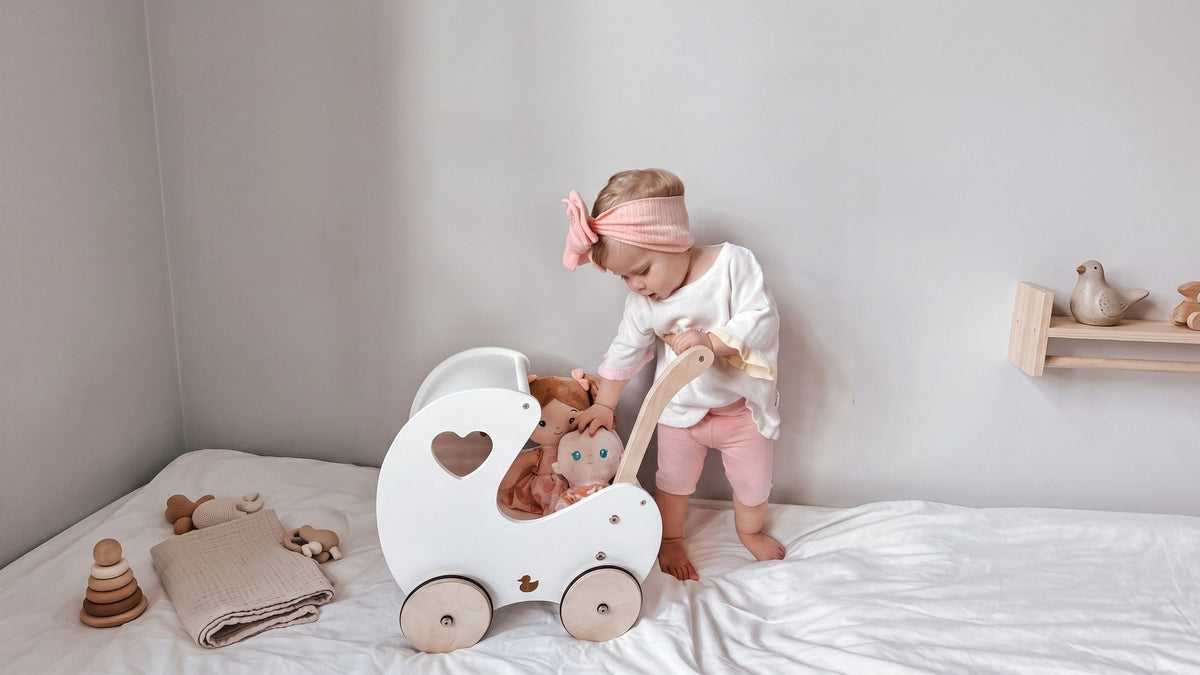
Wooden Doll Prams: A Push Walker With Room for Play
Once a toddler is walking well, pushing something around the house becomes a game in itself, and a doll pram turns that game into a story. A toddler loads a doll, grips the handle and sets off, wheeling their charge from room to room. It is a push walker and a piece of pretend play at once, which is what makes it suit an older toddler rather than a baby taking first steps. This guide covers the right age for a wooden doll pram, what the pretend-care play adds, and how it compares to a first push walker.
In This Article:
- A Doll Pram That Doubles as a Walker
- The Right Age for a Doll Pram Walker
- What Pretend-Care Play Adds
- A Closer Look at a Wooden Doll Pram
- Doll Pram or First Push Walker?
- Using It Safely and Keeping Play Going
- Frequently Asked Questions
A Doll Pram That Doubles as a Walker
A doll pram is a small stroller a child pushes with a doll or soft toy aboard, and mechanically it works just like a push walker: a handle, a steady set of wheels, and a child walking behind it. The difference is what it carries. Where a first walker holds blocks in a tray, a doll pram holds a doll a child is looking after, and that turns a lap of the room into a small errand with a purpose.
That bit of story is the point of a doll pram. A toddler is not just moving for the sake of it, they are taking their baby for a walk, which keeps them pushing far longer than an empty cart would. The walking practice comes along for free, wrapped inside a game the child is directing themselves.
Because it is a real push toy rather than a token one, a wooden doll pram is built to be leaned on and steered hard. A solid frame and steady wheels mean it holds a line while a toddler pushes it at speed, and it stands up to the daily handling a favourite pushing toy gets.
The Right Age for a Doll Pram Walker
A doll pram suits a toddler who is already walking with confidence, not a baby taking first steps. The doll pram walker in our range is suitable from around twenty-four months, an older starting point than a first push walker, and the age is worth paying attention to.
The reason is balance. A confident two-year-old can push, stop and steer, so a doll pram becomes a toy they control rather than one that controls them. A younger baby who is still finding their feet can lean too hard on a light pram and tip it, which is frustrating for them and no help to their walking. The steadier the child, the better a doll pram works.
For a baby who is only just pulling to stand, a sturdier first walker built for that stage is the better start, and a doll pram comes into its own a year or so later. Matching the pram to a toddler who already has walking sorted is what lets the pretend play, rather than the balancing, take centre stage.
What Pretend-Care Play Adds
Pushing a doll around is more than exercise for a toddler. Caring for a doll, tucking it in and wheeling it off for a walk, is some of the earliest pretend play a child does, and it is how they practise the looking-after they see the adults around them doing. A doll pram gives that play a set of wheels and somewhere to go.
The pushing itself keeps building the physical side too. Steering around furniture, backing out of a corner and keeping the pram straight all sharpen a toddler's coordination and control, the next layer of skill on top of plain walking. A child gets better at moving their body through a room by moving something else through it.
It is also open-ended in a way a single-use toy is not. One day the doll is going to the shops, the next it is the family pet or a load of washing, and the pram bends to whatever the child invents. That kind of play grows with a child's imagination rather than wearing out once the novelty fades.

A Closer Look at a Wooden Doll Pram
The wooden doll pram walker in our range is made from durable birch plywood, hand-polished with rounded edges and a water-based, non-toxic finish. It suits a toddler from around twenty-four months, the walking-with-confidence stage where a doll pram earns its keep.
It keeps things deliberately simple. The handle is a single solid piece at a fixed height of 450 mm with no moving parts, which is part of why it holds up to hard pushing, and the wheels carry a soft rubber trim so the pram rolls smoothly and stays gentle on the floor. At 450 mm long and 250 mm wide it is sized for a toddler to push and steer without it getting away from them.
It is made to carry a doll or soft toy, not a child, so a toddler walks behind and pushes rather than climbing aboard. That keeps it steady and keeps the play where it belongs, in the pushing and the pretend rather than the riding. See it in the baby walker range next to the first push walker.
Doll Pram or First Push Walker?
The two suit different ages and different jobs. A first push walker is for a baby from around twelve months who is pulling to stand and needs a steady handhold to step behind. It is heavier and lower, with a toy tray, built to steady wobbly early steps rather than to tell a story.
A doll pram is for the toddler that baby becomes, from around twenty-four months, when walking is sorted and pushing turns into pretend play. If you are choosing for a baby just finding their feet, start with the first walker. If your child is already walking well and after a pushing toy with a game built in, the doll pram is the one.
Plenty of families end up with both across a couple of years, moving from one to the other as a child grows from first steps to confident, imaginative walking. Reading where a child is up to, the same way you would before a big toddler step like starting childcare, points you to the right one for now.

Using It Safely and Keeping Play Going
A doll pram is safest with room to move. Give a toddler a clear, flat stretch of floor away from stairs, with no rugs to snag a wheel or cords in the path, so they can push and turn without pitching the pram forward. Smooth timber and tile suit it best, while a thick rug can stop a wheel and unsettle a fast-moving toddler.
Keep the rule simple: the pram carries a doll or a soft toy, and the toddler walks behind it rather than sitting or riding on it. It is built to be pushed, not to take a child's weight, and pushing is where all the walking and pretend value comes from. Stay nearby while a younger toddler is getting the hang of steering it.
To keep the game fresh, let the pram be more than a pram. A different passenger, a new destination, a delivery run around the house, and the same toy carries months of play. Browse the baby walker range to see the doll pram and the first push walker together and pick the one that fits your toddler's stage.
Frequently Asked Questions
What age is a wooden doll pram walker for?
A doll pram suits a toddler who is already walking with confidence, usually from around twenty-four months. The doll pram walker in our range is suitable from about twenty-four months. A younger baby still finding their feet can tip a light pram, so a sturdier first walker is the better start for them.
Is a doll pram the same as a baby push walker?
Mechanically they work the same way, a handle and steady wheels a child pushes from behind, but they suit different ages. A first push walker steadies a baby's early steps from around twelve months, while a doll pram adds pretend care for an older toddler who is already walking well.
Can a child sit or ride in a doll pram?
No. A wooden doll pram is made to carry a doll or a soft toy, not a child, so a toddler walks behind and pushes it. It is not built to take a child's weight. Keeping to that is what keeps it steady and keeps the play in the pushing and the pretend.
What surface is best for a doll pram walker?
A clear, flat run of smooth timber or tile away from stairs, with no rugs to snag a wheel or cords in the path. A thick rug can stop a wheel and pitch the pram forward, so watch the transitions between surfaces while a toddler pushes.
After a pushing toy with a game built in? Browse the baby walker range and match a wooden doll pram to a toddler who is already walking.





Leave a comment
This site is protected by hCaptcha and the hCaptcha Privacy Policy and Terms of Service apply.