



Indoor Climbing Ladders and Play Sets: Building Up as Kids Grow
Climbing is one of the first big physical challenges a child sets themselves, and a hanging climbing ladder brings that challenge indoors. On its own it gives an older child something to pull up and clamber on; paired with a swing or a set of rings, it becomes part of a setup that keeps offering more as a child grows. This guide covers what age a climbing ladder suits, how the swings, disc, rings and ladder fit together by stage, and how to anchor a set safely in an Australian home.
In This Article:
- Why Indoor Active Play Matters
- The Building Blocks: Swing, Disc, Rings and Ladder
- A Starting Point by Age
- The Climbing Ladder: A Vertical Challenge
- Combining Pieces on One Anchor
- Setting It Up Safely at Home
- Frequently Asked Questions
Why Indoor Active Play Matters
Children need to move, and the weather does not always agree. Long stretches of rain, heat or short winter days keep families indoors, and a child with energy and nowhere to spend it is hard on everyone. Somewhere to climb, swing and hang inside turns that energy into play rather than friction, whatever it is doing outside.
Active play indoors is not only about burning energy, either. Climbing, hanging and swinging build the big-muscle strength, balance and coordination a child needs, the kind of development that comes from moving the whole body rather than sitting at an activity. Bringing that indoors means it is not rationed to fine-weather trips to the park.
The pieces that do this hang from a single anchored point and pack a lot of play into very little floor. A climbing ladder, a swing and a set of rings take up no permanent footprint the way a large frame does, which is what makes real active play realistic in a playroom, a bedroom, or a covered outdoor space at home.
The Building Blocks: Swing, Disc, Rings and Ladder
There are four kinds of hanging attachment, and each does a different job. A swing seat gives the steady back-and-forth motion; a disc swing adds spin and balance; gymnastic rings and a trapeze bar build hanging and pulling strength; and a climbing ladder adds a vertical climb. Together they cover swinging, spinning, hanging and climbing from one fixing point.
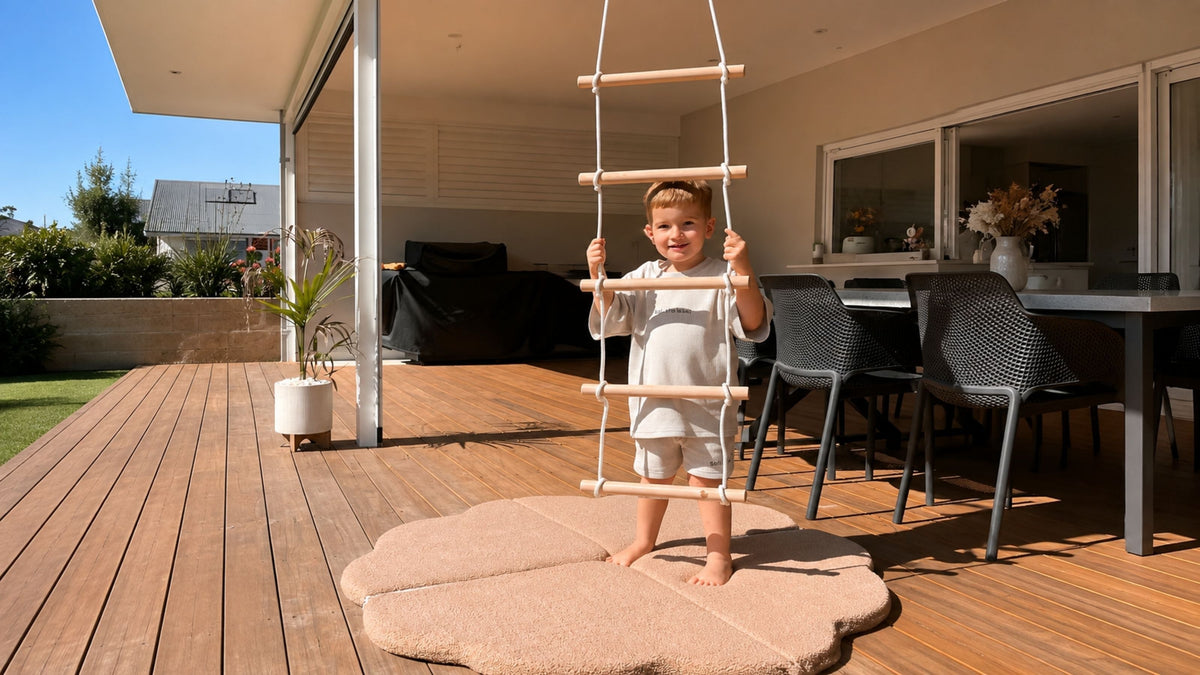
The climbing ladder is the piece that turns play upward. It is a hanging ladder of five beechwood rungs that a child climbs, hangs off and clambers on, and because it swings a little as they move, it asks for more balance than a fixed ladder against a wall. That bit of movement is the challenge, and it is what keeps a child working at it.
None of the pieces needs the others to be worth having, but they combine well because they share the same hanging setup. That means you can start with one attachment and add another later, or swap between them on the same anchored point, building the setup up over time instead of buying it all at once.

A Starting Point by Age
Age decides where a family starts. For a baby or young toddler, the supported baby swing seat is the first piece, suitable from around six months once a child can sit up with support and up to about three years. At this stage the goal is simply gentle, supported movement, not a challenge to conquer.
From around three years, the climbing ladder and the rings and trapeze come into their own. Both suit children three and up and hold a child up to 60 kg, because climbing and hanging need the grip and coordination to hold and control a child's own weight. This is the stage where play stops being about being moved and starts being about what a child can do themselves.
A disc swing and an open swing seat sit in between, suiting a child who has outgrown the supported seat but is still building toward climbing and hanging. Reading the age and weight guidance on each piece keeps the challenge matched to the child, so they meet something they can manage rather than something beyond them.
The Climbing Ladder: A Vertical Challenge
The climbing ladder is built for real clambering. Its five rounded beechwood rungs give a child something to grip and stand on, and the whole ladder hangs on rope rather than leaning on a wall, so it moves as they climb. That movement is the whole point: a child has to hold on and balance, not just step up, which makes a short ladder a proper challenge.
Like the other attachments, it hangs on adjustable rope, so you set how high it hangs and how much of it a child can reach. Set low, the bottom rungs are a first climb for a newer climber; hung a little higher, the full ladder is a clamber and a hang for a stronger, more confident child. You control the challenge by how you hang it.
Climbing tempts children upward, so this is a piece to supervise closely and to set over a soft surface. Keep the floor beneath it clear and forgiving, start a new climber low, and stay close by while they work out how the ladder moves. The reward is a child building real climbing strength and nerve in a spot you can keep an eye on.

Combining Pieces on One Anchor
Because every attachment shares the same rope-and-carabiner setup, they swap onto a single anchored point in minutes. That is the idea behind the play sets, which pair two attachments so a family can start with a combination rather than a single piece. A climbing ladder and swing seat set pairs a climb with a swing, covering two kinds of movement from the day it goes up.
The pairing can also span ages. A baby swing seat and climbing ladder set puts a younger child's supported swing and an older child's climb on the same fixing point, which suits a family with children at different stages or one child growing from one to the other over time.
Swapping attachments also keeps play fresh. A child who has lost interest in the swing finds it new again when the rings or the ladder go up in its place, all on the same anchor. Rotating what hangs there, rather than adding fixing points around the house, is the simplest way to keep one spot earning its keep for years.
Setting It Up Safely at Home
Every piece here hangs from an anchor you provide, and none includes a stand. The fixing point must be a structural ceiling joist or a rated frame that can take a child's full weight while they climb, swing and hang, which is well beyond their still weight. Plasterboard alone is never enough. Finding a real joist or using a purpose-built frame is the first job, before any attachment goes up.
Each attachment comes with the wooden rope locks, nylon straps and screw-lock carabiners to hang it and set its height, and the ropes adjust through a range so you can start low. Set new climbers and hangers close to the floor, keep the landing space under and around each piece clear and soft, and raise the height only as a child's strength and confidence grow.
Keep active play to one child on a piece at a time, and stay close while children are learning what they can do, since climbing and hanging invite them to try the next thing early. Check the fixings, ropes and carabiners regularly once they are in daily use. Browse the full swing and climbing range to see the climbing ladder, swings and rings together and plan a setup that suits each stage as your child gets older.
Frequently Asked Questions
What age is a hanging climbing ladder suitable for?
The climbing ladder suits children from around three years and up, and holds a child up to 60 kg. Climbing and hanging need the grip and coordination to control a child's own weight, which is why it is an older child's piece rather than a toddler's. Younger children start with a supported swing seat instead.
Can I combine a swing, rings and a climbing ladder on one point?
Yes. Every attachment shares the same rope-and-carabiner setup, so they swap onto a single anchored point in minutes. The play sets pair two attachments to start with, and you can rotate what hangs there over time to keep play fresh without adding fixing points around the house.
What surface should go under an indoor climbing ladder?
A clear, soft landing surface. Keep the floor under and around the ladder free of furniture and hard objects, ideally over a mat or another forgiving surface, so a slip is a short and safe drop. Start a new climber with the ladder hung low.
Do the climbing ladder and play sets come with a frame?
No. Every piece hangs from an anchor you provide, with the straps, carabiners and rope locks included to fix it. The anchor must be a structural ceiling joist or a rated swing frame that can take a child's full weight in motion, never plasterboard on its own.
Building an active-play corner? Browse the full swing and climbing range and plan a setup of swing, rings and climbing ladder that suits each stage as your child gets older.





Leave a comment
This site is protected by hCaptcha and the hCaptcha Privacy Policy and Terms of Service apply.