



Rotating vs Flat: Choosing a Kids Bookshelf That Fits the Room
A children's bookshelf comes in two broad shapes, and choosing between them is mostly about your room rather than your child. One spins in place and shows a handful of covers on every side; the other stands flat against a wall and holds far more. Both put covers where a child can see them, but they use space, hold books, and suit an age quite differently. Here is how a rotating and a flat front-facing shelf compare, so you can match one to the corner you actually have.
In This Article:
- Two Shelf Shapes, One Job
- How a Rotating Bookshelf Works
- How a Flat, Front-Facing Shelf Works
- Matching the Shelf to Your Room
- By Age and Height
- Keeping Either One Steady
- Frequently Asked Questions
Two Shelf Shapes, One Job
The job of any children's bookshelf is the same: show covers face out so a child can see what is there and choose a book for themselves. A spine-out shelf, the kind most adult bookcases use, hides every title behind a row of narrow edges a young child cannot read. Face-out display is what turns a shelf into something a toddler will actually walk up to and use.
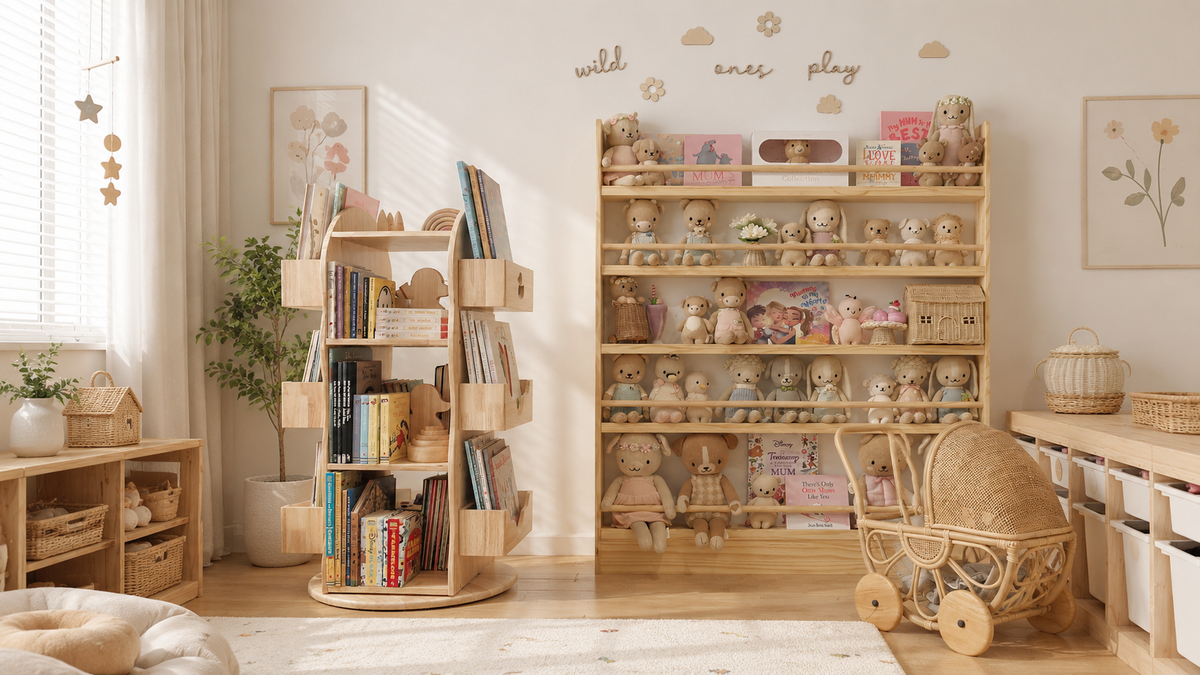
Where the two shapes part ways is footprint and capacity. A rotating bookshelf is a compact bookcase that turns on a base, holding a few covers per side across three or four tiers; you browse it by spinning it, not by walking along it. A flat, front-facing shelf is a wall unit with slanted rows that shows a longer line of covers at once and holds more books before it fills.
Neither shape is the better one in the abstract. A spinning bookcase wins in a tight corner; a flat wall shelf wins where you have a clear stretch of wall and a growing library. Name the room first, then the book count, and the shape tends to pick itself before you compare a single model.

How a Rotating Bookshelf Works
A rotating bookshelf sits on a turning base, so a child steps up to one spot and spins the whole bookcase to see every side. Each tier shows a few covers face out, which keeps the choice small and readable rather than a wall of options. The BINDI and the OLI both work this way, turning smoothly on the base while the frame stays put on the floor.
The strength here is the small footprint. A bookcase like the KOBI tucks into a corner or the end of a room and still shows books on all four sides, so it holds a useful number of covers without needing a length of clear wall. If the library outgrows it, a matching add-on layer stacks on for another tier of covers rather than a second piece of furniture.
The trade is total capacity. A rotating bookcase is built to hold a curated handful of books at a time, not a whole shelf's worth. For many families that limit is a feature, since a smaller selection is easier for a child to manage. But if you are storing dozens of books, a bookcase will fill quickly and the flat shape starts to make more sense.
The three revolving bookcases compare like this at a glance. Book counts are approximate and depend on book size:
| Model | Timber | Spins 360° | Holds | Height add-on | Drawing scroll | Pegs & hooks | IKEA storage boxes |
|---|---|---|---|---|---|---|---|
| OLI | Beechwood | Yes | ~350 books | No | Yes | No | Yes |
| KOBI | Rubberwood | Yes | 300–400 books | Yes | No | Yes | No |
| BINDI | Rubberwood | Yes | ~300 books | No | No | No | No |
How a Flat, Front-Facing Shelf Works
A flat front-facing shelf stands against a wall and shows its books on slanted rows, covers out, the same way a shop displays them. The NALA Adjustable Bookshelf is built this way, and its shelves adjust in height, so you can set the rows to suit the books you own and change them as the collection grows.
Because it uses the wall rather than a turning base, a flat shelf holds far more at once. A whole row of covers faces the room, so a child can scan the choices in a glance rather than spinning to find them. That makes it the better fit for a dedicated reading corner or a bedroom wall where books are the main event and the floor in front stays clear.
What it asks in return is wall space and a fixed spot. A flat unit does not shrink or move out of the way between uses, and the taller it is, the more it wants to be anchored to the wall behind it. In a room with a clear stretch of wall that is no trouble; in a shared or crowded space, the spinning bookcase is usually the easier of the two to live with.

Matching the Shelf to Your Room
Start with the floor, not the shelf. In a small bedroom, an apartment, or a corner of a shared living room, a rotating bookcase earns its keep because it holds a real selection in a footprint the size of its base. You lose no wall, and a child can circle it from one spot.
Where you have a clear wall and a growing pile of books, the flat front-facing shelf is the stronger choice. It turns an empty stretch of wall into a display a child can read across, and its adjustable rows mean it keeps pace as the books get taller or more numerous. A reading nook, a playroom wall, or the foot of a bed all suit it well.
Book count is the other half of the decision. If your child reads from a rotating handful of favourites, a bookcase keeps that selection tidy and turning. If you are housing a library that keeps growing, the flat shelf holds more and is quicker to tidy, since every book has an obvious slot to slide back into.
By Age and Height
Age nudges the choice too. A rotating bookcase suits a younger child well: it stands at a height they can browse on their own, and turning it is part of the fun of choosing. The covers sit where a toddler can see and reach them without help, which is the whole point of a face-out shelf at this age.
A flat shelf grows with the reader in a different way. Its adjustable rows let you keep the everyday books on the tiers a child can manage themselves, while the higher rows hold the ones you hand down or read together. Be honest about height as you set it up: on a taller unit, or the upper tiers of any shelf, the top rows are an adult's job to reach, and that is fine. Put the books a child chooses alone on the rows they can actually see.
For most homes the split is simple. Under three, in a bedroom or a corner, a rotating bookcase is the friendlier first shelf. As the library and the reader both grow, a flat front-facing shelf holds the collection and keeps the day-to-day books at a height the child owns.
Keeping Either One Steady
Whichever shape you choose, steadiness comes first. Both a rotating bookcase and a flat shelf are built on a wide base to sit firmly on the floor, but a child leaning, climbing, or pulling on a shelf is a different load than books alone. Anchoring the unit to the wall with a strap is the single most useful thing you can do, and it matters more the taller the shelf stands.
A rotating bookcase asks for one extra check: that it turns freely but does not tip when a child pulls on one side. Set it on a firm, level floor rather than deep carpet, and keep the heavier books on the lower tiers so the weight stays down near the base. A flat shelf wants its back against the wall and, where the room allows, a strap into a stud so it cannot rock forward when a drawer or shelf is loaded.
Solid timber helps on both counts, since the weight of real wood keeps the base planted. None of this takes long to set up, and it is worth doing on the day the shelf arrives rather than later. A quick check every few months that the strap is still firm and the base still sits level keeps a well-used shelf as steady on its hundredth spin as it was on its first.
Frequently Asked Questions
Is a rotating bookshelf better than a flat one for a small room?
Usually, yes. A rotating bookcase holds a real selection of books in a footprint the size of its base, so it fits a corner or a small bedroom without needing a length of clear wall. A flat front-facing shelf holds more but wants a clear stretch of wall to stand against.
How many books does a rotating bookshelf hold?
A rotating bookcase is built for a curated handful, a few covers per side across three or four tiers. That smaller selection is easier for a young child to manage. If you are storing dozens of books, a flat adjustable shelf holds far more at once.
What age is a rotating bookshelf for?
A rotating bookcase suits younger children well, roughly toddler age and up, because the covers sit at a height they can see and reach on their own and turning it is part of choosing. Older readers with a bigger library are often better served by a flat front-facing shelf.
Should a kids bookshelf be anchored to the wall?
Anchoring is strongly recommended for any shelf a child can reach, and it matters more the taller the unit stands. A wall strap stops the shelf rocking forward if a child leans or pulls on it. Keep heavier books on the lower tiers so the weight stays near the base.
Weighing up the two shapes? Browse the full kids bookshelf range and match a rotating bookcase or a flat front-facing shelf to the room you have.





Leave a comment
This site is protected by hCaptcha and the hCaptcha Privacy Policy and Terms of Service apply.