
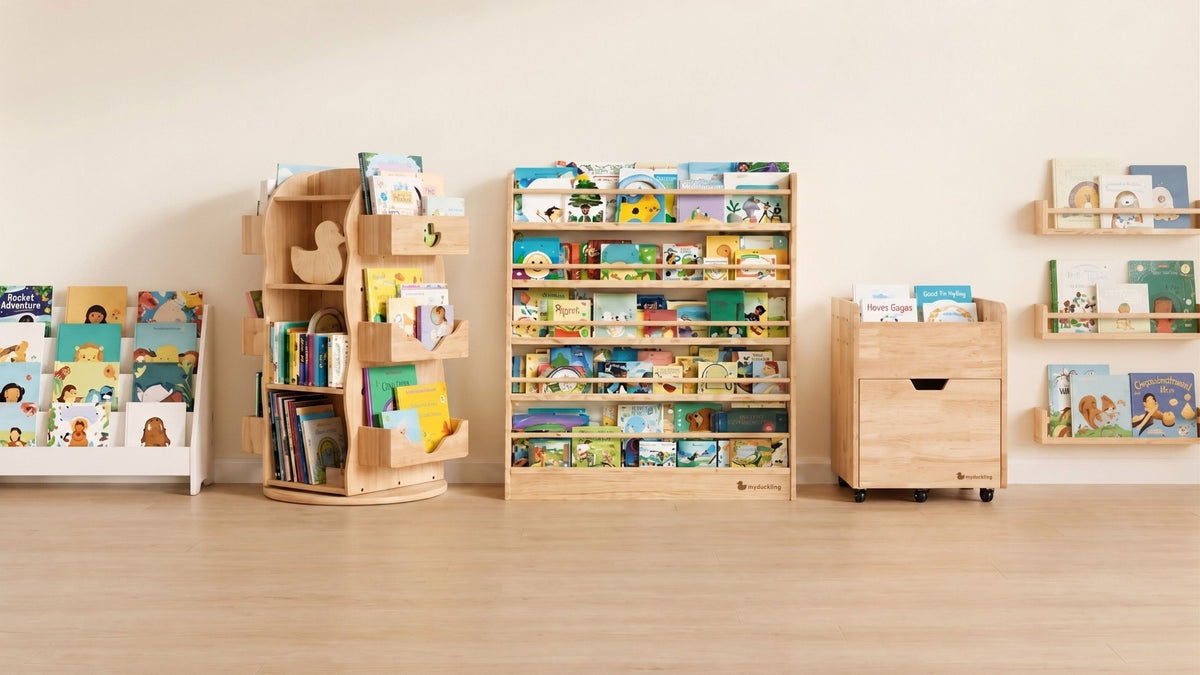
Kids Bookshelves With Storage: Books and Toys in One Spot
Not every room has space for a bookshelf and a toy box both. When one piece has to do two jobs, the question stops being how many books it holds and becomes how well it sorts books and toys without turning into a jumble. Here is a plain guide to kids bookshelves with storage, the shapes they come in, and how to pick the one that suits the room you actually have.
In This Article:
- When One Piece Has to Do Two Jobs
- Open Shelves and Bins
- A Shelf That Holds More
- Storage That Moves With the Play
- Keeping Books and Toys Sorted
- Choosing for Your Room
- Frequently Asked Questions
When One Piece Has to Do Two Jobs
Books and toys want different homes. Books are best shown cover out, upright, where a child can see and choose them. Toys want a bin or an open shelf they can be tipped into and scooped back out of. A piece that holds both has to offer two kinds of space at once, which is why a plain bookshelf and a plain toy box rarely swap jobs well.
The pieces that manage it combine a face-out book row with open shelving or bins below, so books stay displayed while toys go into containers a child can carry. Done well, one unit clears the floor of two problems: the pile of books with no home and the toys with no shelf. Done badly, it becomes a single messy heap. The difference is in how clearly the piece separates the two kinds of storage.
So the first question is not capacity but division. How much of the unit shows books, how much holds toys, and can a child tell which is which? A piece that answers that clearly is worth more in a busy room than one that simply holds more.
It also helps to think a season ahead. A toddler's shelf is mostly board books and a few soft toys; a year on it is longer picture books, puzzle boxes, and the odd game with pieces that must not scatter. A unit that mixes open shelving with room for bins takes that shift in its stride, because you can move a book row up, swap a shelf for a bin, or hand the whole lower level over to toys as the balance changes. Buying for the child you have and the one arriving shortly saves a second piece down the track.
Open Shelves and Bins
The most flexible book-and-toy piece is an open unit with a mix of shelves and room for bins. The NALA Multi Purpose Storage Unit works this way, giving you open compartments that take books stood up, toys laid in, or a fabric bin dropped in for the loose pieces that never stack. It suits a playroom or a bedroom where the contents change as a child does.

Open compartments earn their place because a child can both see in and reach in. Nothing is hidden behind a door, so tidying up is a matter of putting each thing back in its cubby rather than opening and closing anything. Give each compartment a job, books here, blocks there, cars in the bin, and a young child learns where things live surprisingly fast.
The bins are what make it work for toys. Loose pieces, soft toys, and the odd shapes that will not stand on a shelf go into a container a child can lift out, carry to the rug, and carry back. Keep the heavier bins in the lower compartments so the weight stays down near the floor and the unit stays planted.
A Shelf That Holds More
Where books outnumber toys, a taller storage shelf carries the load. The NALA 3 Layer Storage Shelf gives you three full tiers, enough to keep a growing library and still leave a level for baskets of toys or craft supplies. It is the piece for a room where the reading has taken over and the toys are the smaller half.
Three tiers let you sort by who reaches what. The lower two hold the books and toys a child manages on their own; the top holds the ones you hand down or keep for reading together. That vertical split does the same job a face-out row does horizontally: it puts the everyday things where a child owns them and the rest a step up out of the daily shuffle.
A taller shelf asks for anchoring more firmly than a shorter one. Its extra height is exactly what makes it want a strap into the wall behind, so it cannot rock forward if a child leans or reaches. Load the lower tiers heavier than the top and the shelf sits all the more solidly.
Storage That Moves With the Play
Some days the play moves from room to room, and the storage may as well move with it. A NALA Trolley puts books and toys on wheels, so a child can roll the current favourites from the bedroom to the living room and back rather than carrying armfuls or leaving a trail.
A trolley suits a home without a single dedicated playroom, where activity follows the family around the house. Loaded with a few books, a craft set, or the toys of the week, it becomes a mobile station a child can park beside the couch after lunch and wheel back to their room at night. Because it holds a small selection, it also nudges the same edited approach a face-out shelf does: only what fits, only what is in use.
Wheels do ask for a level floor and a lock or a firm resting spot, so the trolley stays put once a child sits down to it. Keep the load modest and low on the trolley, and it rolls easily without becoming top-heavy as it travels.
Keeping Books and Toys Sorted
Whatever piece you choose, the habit that keeps it working is giving every kind of thing one clear home. Books cover out on the display row; blocks in one bin; soft toys in another; the odd pieces in a basket. A child cannot tidy a jumble, but they can put a car back in the car bin, so the sorting you set up is the sorting that lasts.
Keep the display side sparse for the same reason a Montessori shelf does. A handful of covers on show, the rest resting in a box you rotate through, means the book side never becomes a wall a child stops seeing. The toy side can hold more, since a bin is meant to be dug through, but even there, fewer bins with clearer jobs beat many bins of mixed everything.
For more on choosing and setting up the display side, see our kids bookcase guide. The same principle, a small chosen selection a child can see and reach, is what keeps a book-and-toy unit from sliding back into a heap.
Choosing for Your Room
Match the piece to where it will stand. In a shared living room where the floor clears each night, an open unit with bins keeps books and toys sorted against one wall and tidies fast. In a bedroom where reading leads and toys trail, a taller three-tier shelf holds the library and still leaves a level for baskets. In a home where play travels, a trolley carries a small kit between rooms.
Footprint decides the rest. Measure the wall or corner you have before you choose, and remember an open unit needs clear floor in front for a child to reach in and tidy. Solid timber weighs more than flat-pack board, which is part of why these pieces sit so steadily, so plan the spot before it arrives rather than shifting it around after.
Above all, pick for how your room actually runs. A piece that suits the way your family moves through the day gets used and stays tidy; one chosen only for capacity tends to fill and stall. Books and toys in one spot works when the spot fits the room.

Frequently Asked Questions
What is the best kids bookshelf with storage?
It depends on the balance of books and toys. An open unit with bins suits a mix of both; a taller three-tier shelf suits a bigger library with some toy storage; a trolley on wheels suits a home where play moves between rooms. Match the shape to your room rather than to capacity alone.
Can one unit hold both books and toys?
Yes, as long as it offers two kinds of space: a face-out row or shelf for books shown cover out, and open compartments or bins for toys. Give each compartment one job so a child can tell where things live and put them back on their own.
Are open storage bins good for a toddler's room?
Open bins work well because a child can both see in and reach in, so tidying is a matter of dropping each thing back in its bin. Keep the heavier bins in the lower compartments so the weight stays near the floor and the unit stays steady.
Should a storage shelf be anchored to the wall?
Yes, and the taller the shelf the more it matters. A wall strap stops the unit rocking forward if a child leans or reaches for a top shelf. Load the lower tiers heavier than the top so the weight sits near the base.
Sorting out books and toys in one room? Browse the bookshelf and storage range and match a unit to the way your room runs.





Leave a comment
This site is protected by hCaptcha and the hCaptcha Privacy Policy and Terms of Service apply.